The Joy Is in the Process: Korora’s AI Policy and What We Mean To Preserve With It
Have you been to a concert recently and noticed a few singers’ faces are uplit from their glowing iPads as they sing? Scanned a QR code to access a program, or pulled up a ticket from your digital wallet? Been tempted to check out an ensemble because of a funny Instagram reel?
It’s safe to say that choirs love technology, and we’re doing our best to keep up with the times – even with an artform that’s centuries old.
But what about the newest technology to enter the scene? The one that is seemingly everywhere these days? The one that has you wondering is that even real way more often than you’re comfortable with as you scroll on your phone?
What happens when choirs intersect with AI?
Like everyone else in the arts, this is a question I’m grappling with! When I first started seeing AI popping up in poster art, or promotional posts about choral auditions, or grant applications to foundations, I began to feel a deep sense of unease. I started asking colleagues inside and outside of our organization, posing a classic Executive Director question: do you have a policy on AI use?
But the answer from everyone was the same: No, we don’t. That was followed by one of two sentences: either We haven’t thought about it before! Or We think it’s too soon to make a policy, the technology is so new.
New or not, I could see for myself on social media that professional visual artists in our community were being passed over in favour of generative AI artwork that was free, quick to access, and – apparently – “good enough”.
As musical artists ourselves, were we playing a part in making other (visual) artists’ livelihoods even more precarious?
The more I learned, the deeper my unease went. We don’t really know what material AI is being fed, where its ‘learning’ is happening. But we can see for ourselves that AI is stealing from visual artists, and none of them are being compensated for that work being repackaged and given away by these platforms.
It didn’t sit right with me. In the choral world, we pretty much all agree that living composers deserve to be paid. We know nobody should be transcribing a piece or “remixing” it without getting permission from the composer, and certainly not without crediting them. We are very aware that our ability to access and perform new music hinges on making sure our composers are recognized and compensated for their work!
But it felt like we were not extending that same courtesy to our visual artist colleagues. We were taking computer-generated “remixes” of their artwork and using it to promote our own artistic work. I completely understand the appeal of getting that work done without having to find the money in our forever-strapped nonprofit budgets! But what is the real cost for our artistic compatriots?
[Note: I’m leaving aside the known disastrous environmental impact of data centres. But those are also significant!]
Then came Suno, and other similar generative music AI platforms. In under a minute, you can have one of these sites generate a piece of music, even a new text, given a prompt of your choosing. Again, it’s not clear where these platforms are sourcing their training material (though many artists have come forward to point out very distinctive sounds and voices as being drawn from their own work) but it is absolutely clear that no artists are benefiting from this use of their work.
In fact, there’s a band on Spotify that has amassed over 600,000 monthly listeners in spite of being openly AI-generated; either its followers know it’s AI and don’t care, or they can’t tell it’s AI. Both are pretty troubling options for musicians to contemplate!
After many enlightening conversations with fellow arts administrators, conductors, and artists, I did what Executive Directors do: I sat down and wrote a policy.
Here’s how it begins:
Human creativity and human creative labour are at the very core of our work in the Korora Choir Association.
Without humans being creative and making new art together, we wouldn’t have our community of singers and learners. We simply wouldn’t exist if everyone felt that it was easier and better to just type a prompt into a field and wait for the results to pop up.
But we know what all choral artists know: that the true joy is in the process. It’s in the struggle, in the challenges, in the learning, in the mastery. We know that we never feel more connected, more enlightened, or more engaged than when we make it through a new score and experience that new sound together, created with nothing more than our voices, our determination, and our listening.
We don’t want a shortcut to that feeling. In fact, there is no shortcut to that feeling. It’s borne out of collective creative effort, and it can’t be duped or faked or generated from a prompt. We learn best when we learn from each other.
So where does Korora land when it comes to generative AI and our choir family?
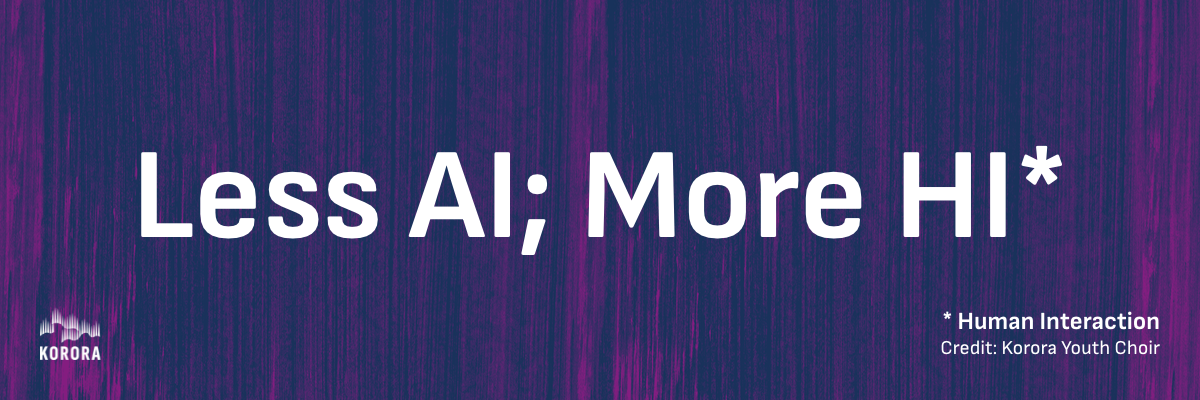
We have committed to choosing human artists over computer platforms everywhere we can: from concert posters to promotional writing, from programming choices to uniform designs, from rehearsal schedules to funny Instagram posts.
The world is changing very quickly, and we know we’ll need to look at this policy all the time as the landscape shifts; but we know that one thing that won’t change is that art is about expression, and humans are the ones who need to be making art.
So, actually, it’s simple: we choose human art and artistry every time.
Period.